A Peace That Walks
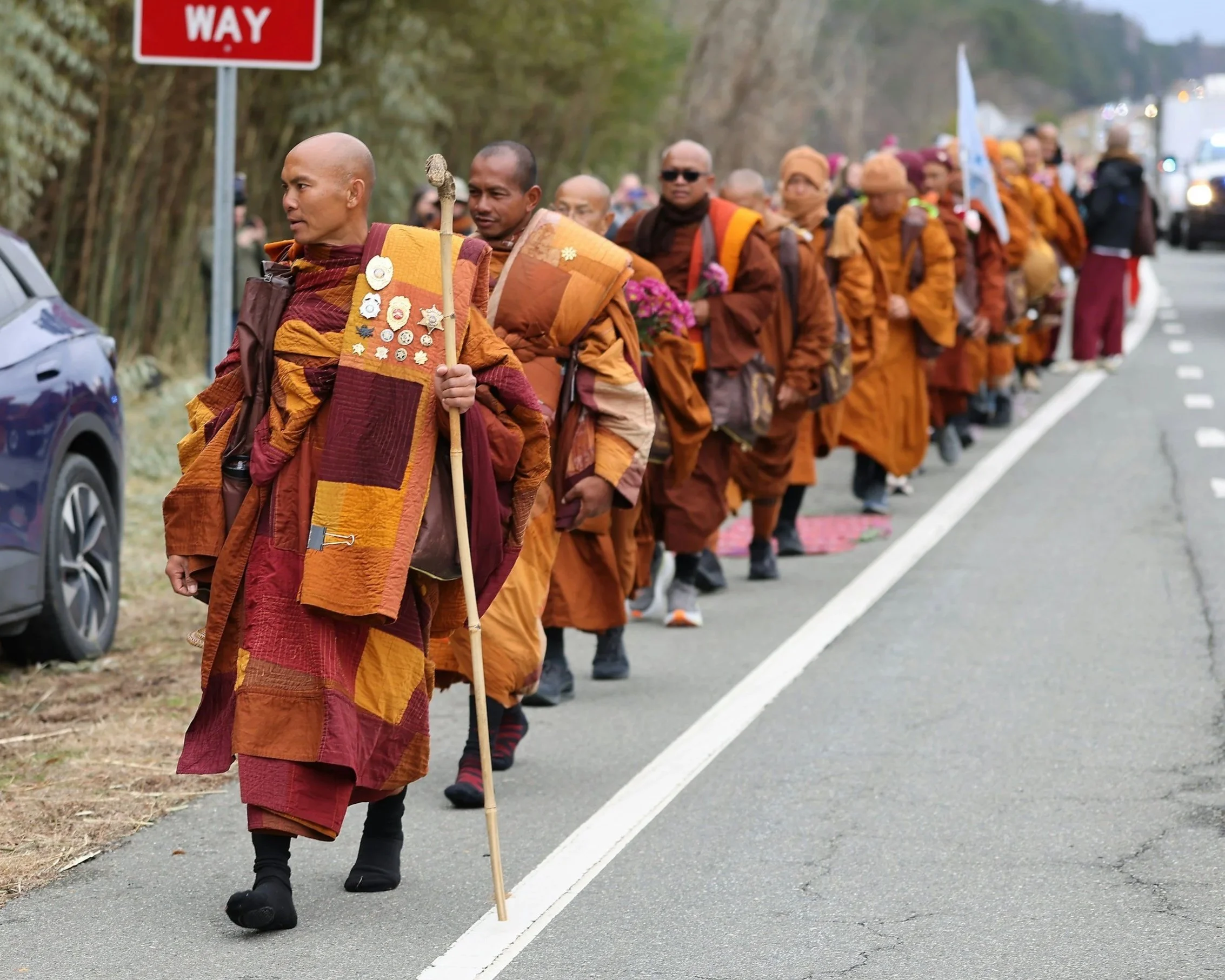
Buddhist monks walk from Texas to Washington, D.C. to teach peace (Oct. 2025-Feb. 2026).
Yours is the light by which my spirit’s born: – you are my sun, my moon, and all my stars. ~ E.E. Cummings
Celestial bodies that have inspired travellers for over 300,000 years, guided the journey of the Magi seeking the Prince of Peace. God’s greatest reveal to humanity led them to follow the Star of Bethlehem, pulled by the magnetism of an infant in a manger. Did they find what they were looking for?
When they saw the star, they rejoiced exceedingly with great joy; and going into the house they found the child with Mary his mother, they fell down and worshipped him. –Matthew 2:10-11
The biblical story portrays three Magi who travelled from the East. They might have journeyed at least 800 miles from Persia or Babylon, beckoned by the light of a star and pulled by a quest to go and see the divine and human God-man. Driven by a clear purpose toward something sacred and life-changing, the Magi followed the star of Bethlehem until it rested over where Jesus lay. Born like you and me with the fragile body of an infant, Jesus invites us to come close to the manger, to tenderly touch the hands and feet of the Incarnation of God! This was revealed to the Magi as they fell prostrate with humble deference and astonishment. Recognizing the Light of the World knocked them off their feet and rendered them face down on the ground. I can’t imagine responding in any other way.
Artists have long depicted the Magi kneeling motionless and solemn in their royal dress, holding out their gifts before Jesus. Matthew writes, “They fell down and worshipped him.” I imagine they were unable to maintain their normal demeanor. Kneeling would not have been enough of a response to the One called Emmanuel. They witnessed God’s revelation in Jesus who would reconcile, restore and redeem all of creation back to God (Colossians 1:20). Such disclosure would have transformed the Magi, prompting them to return home a different way.
And having been warned in a dream not to return to Herod, [the Magi] left for their own country by another road. –Matthew 2:12
This encounter of the Incarnation prompted the Magi to experience metanoia, a profound change of mind, heart or way of life. Hearts and minds exploded with adoration and wonder for the gift of God’s very self in human form. What started as a mission to seek divine presence transcended their expectations. They encountered the cosmic mystery of God in a human body like their own. Their gifts of gold, frankincense and myrrh communicated more than they could comprehend. How could they know how Jesus’ life would play out?
Even without knowing how Jesus’ life and ministry led to tremendous suffering and death, the Magi honored the Christ child that would usher in peace to the world. Not a peace of complacency or ignorance, but a peace that sees reality and moves in the direction of justice, compassion and loving kindness. A peace that walks with purpose, changing hearts and minds along the way.
The Walk for Peace
I am in awe of the eighteen Buddhist monks in their Walk for Peace that started out from Fort Worth Texas in October 2025 and will end in Washington, D.C. in February. In their 120-day and 2300 mile walk, they are showing the world that peace can be nurtured with mindfulness, determination, tenderness and compassion. They remind us that there are many things we cannot control, but there are ways we can respond to the injustices in our midst. Of the many people who are meeting them on the road, one person said, “there is a thirst for hope and peace in what feels like a very dark time.” Somehow, these smiling and gracious monks are showing us all that we can do something to stand up for those facing injustice.
And in their steps, 20-30 miles per day in sub-zero temperatures, they are walking with purpose. They decided not to hide from the world in their temple but to go out and touch lives with their determination, their silence, their smiles and touch. A 99-year-old woman felt a pull to meet the monks on a rural road in South Carolina. They approached, walking swiftly but paused to bless and honor this elderly mother in her wheelchair, tying a peace cord around her wrist. She offered flowers to pay her respects. Every monk that walked past honored her with a glance, a smile, a nod. She shared with her daughter that she felt the most peace she had ever felt when she went to bed that night.
Just as the Magi gave gifts to Jesus, the monks give away the flowers that others give to them as a way of passing on the blessings. With a detachment to possessions that frees them to give away nonessentials they teach simplicity and presence. And they keep walking. Emboldened by their resoluteness, people on the roadsides witness a peace that has awakened. The late John Lewis called this kind of action “good trouble.” Except, the response to these monks has been overwhelmingly one of welcome and hope. Soon, when they arrive in Washington, D.C. they will have carried with them a lasting peace and hope in humanity.
The magnetism of the monks draws us out to walk, too. As they walk toward D.C., by their example they encourage metanoia, a change of direction in those who lead our nation. They invite us to wake from our stupor, to stop allowing fear to paralyze us. Together, in the beloved community they are creating along the road across the states, we see there is power in numbers and nonviolent action.
The monks walk for a greater purpose than changing the direction of the administration. They teach that peace comes from within, that every person has the capacity for peace, for loving kindness. Be mindful of the present moment and do not seek it outside of yourself. And from within, we can walk in whatever capacity we can toward a lasting peace. And while these monks are Buddhist, it is clear that their building of a beloved community on the roads of America echoes the message of Jesus. Love your neighbor as you love yourself. Seek justice for the poor, the forgotten, the stranger. Give consent to the peace and love of Christ that dwells in you. Protect the dignity of all people. These words echo Buddha’s teachings that we should treat others with profound respect, compassion and humility.
Pope John XXIII wrote the encyclical, Pacem in Terris (Peace on Earth) in 1963:
“We deem it opportune to remind our children of their duty to take an active part in public life and to contribute toward the attainment of the common good of the entire human family as well as to that of their own political community. They should endeavor, therefore, in the light of their Christian faith and led by love, to insure that the various institutions—whether economic, social, cultural or political in purpose—should be such as not to create obstacles, but rather to facilitate or render less arduous man’s perfecting of himself in both the natural order and the supernatural.... Every believer in this world of ours must be a spark of light, a center of love, a vivifying leaven amidst his fellow men. And he will be this all the more perfectly, the more closely he lives in communion with God in the intimacy of his own soul” [bold my own]
― Pope John XXIII, Pacem in Terris: On Establishing Universal Peace
I want to hold fast to a blessed hope, even when the light of the Incarnation seems to dim underneath the shadows in our current world. The darkness of the Roman Empire did not put out the light of Jesus’ birth or his ministry, even after putting him to death on a cross. God-with-us remained and still remains.
With the neverending onslaught of shocking and disturbing events in our nation and world, the story of the Magi and their encounter with the Son of God gives new insight. How do we find courage and trust that God, Creator of All, the Great Architect of the cosmos, the One who loves us beyond our understanding, exists and is not a bystander in the midst of chaos and strife?
These can be overwhelming questions as we live day to day. And this is what we know. God continues to create, continues to be present, to hold and sustain us even in incredible suffering. If I can believe that, even just a little, then I can find the courage to pray, discern, and act with a “disarming” and “unarmed” peace, spoken by Pope Leo in his message for the World Day of Peace on January 1st. “Peace exists,” he said, “it wants to dwell within us.” Buddhist teaching says, “There is no path to peace, peace is the way.”
What is mine to do in this present moment?
Courage, belief in a God that cares for us, who knows and suffers with us, a merciful God who waits for us all to change direction, as the Magi did after their encounter with the Incarnation. Prayer that changes me, allowing the Spirit to transform my fear and free me to respond with bravery; love that heals. Contemplation and action, continuing to recognize the truth (as the Magi did), the reality of what is taking place. Without rhyme or reason, without divine understanding, we cannot know how or why any of this works. But we can know that the Shaper of Life is very much alive, present and active in our world.
There is an awakening that is stirring in the hearts of Americans. I can only attribute this awakening to the Spirit of God bringing us to our feet to defend the weak and defenseless. With pride, I witness the many nonviolent protests around the country, including the many speaking out in Minnesota at the chaos and unchecked brutality of ICE. My heart swells as I realize the countless public servants who feed and provide shelter for those on the fringes of society, despite budget cuts and pressure to quit. For those committed to truthful journalism despite unprecedented pressure to speak a specific narrative. For church leaders unafraid to call out injustice and light a fire in their congregations to serve, to love and to be living examples of Jesus. For those who remind me of my Baptismal call to be a beloved daughter and son of God, leading others by love and for love.
Where did the Magi go after leaving the divine and human infant in the arms of Mary? The story does not spell it out. I think the question for us is: In what direction will we walk after witnessing the Incarnation that is present in people, in Sacrament and in all of creation? Which way will we turn?
Call to Action: In the comments below or in your journal, reflect on the questions posed in the blog:
How do we find courage and trust that God, Creator of All, the Great Architect of the cosmos, the One who loves us beyond our understanding, exists and is not a bystander in the midst of chaos and strife?
What is mine to do in the present moment?
Song for Reflection: “One” by Birdtalker.