Thoughts on Assisi
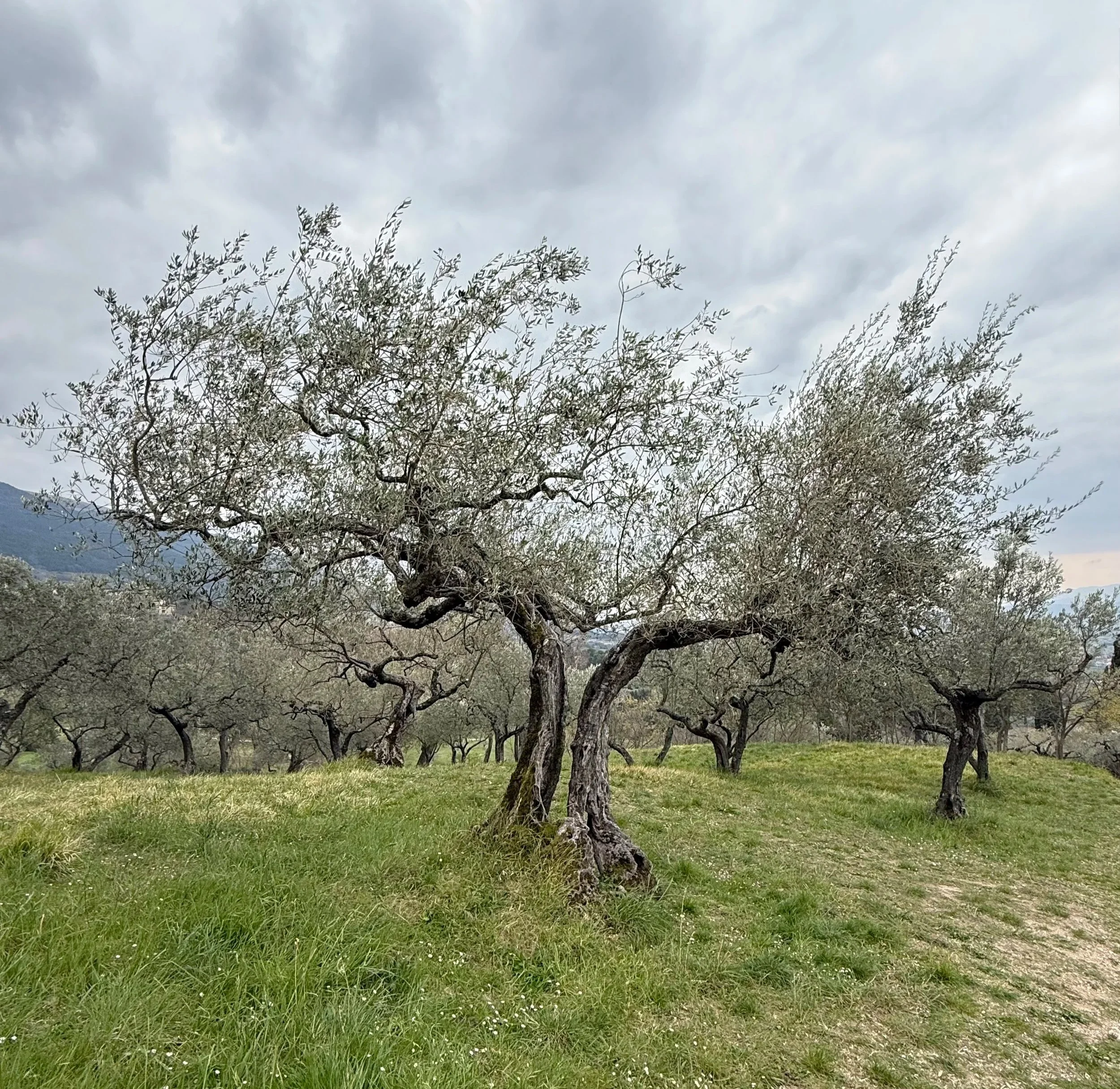
Olive tree on the road to San Damiano Convent, Assisi
Ancient olive groves surrounded me on both sides of the stony path leading to the Convent of San Damiano in Assisi. One particular tree had something to teach me and I stopped to take it in. What should have been two separate trees was one, as if something ethereal held it together. Though fractured, the tree was whole.
Take a moment and gaze at this magnificent olive tree, allowing your eyes to wander across its shape. Something uplifted, shaped, and held it together over the centuries, creating a mysterious unity in its form that started from the ground where the gnarled trunk split at its foundation. Was it the trauma of a frost, the constriction and expansion of the trunk that cleaved it in two? From the root hairs under the soil to the reach of the curved branches that form the crown, the canopy of leaves protects the dancers that move with the wind.
Like a portal to a world beyond this one, a gateway to the sacred, It did not block our vision. The tree split as it began to emerge and grow toward the sky; a brother and sister stretching their trunks. “Stay with me,” she said to her brother, “and together we can heal this fractured world.” And so the trunk became branches and held the limbs, leaves and the olives it produced. Lasting fruit for a world in need of sustenance.
I continued walking toward San Damiano, the site of a profound sacred encounter between Francis and the Divine. Here, he heard God’s voice from the crucifix instructing him to “go and repair my Church” in 1205. Leading up to this profound moment, Francis experienced fractures in his own life.
As the son of a wealthy cloth merchant in Assisi, Francis lived a life of privilege and ease, troubadours and joviality. At the age of 21, he fought in the brutal Battle of Collestrada, across the valley in Perugia. There in 1202, he participated in and witnessed the violence of hand-to-hand combat and the slaughter of friends and classmates in a devastating, losing battle. It’s quite possible that Francis killed others in this conflict. He was taken prisoner for a year and forced to survive in a dark and damp pit where he experienced squalor, starvation, sickness and uncertainty. He didn’t know what would become of him and was uncertain if his family knew he was alive.
After a ransom was secured, Francis was not the same jovial and carefree self. He may have carried with him the trauma of the battle, the guilt of surviving when friends died, surviving because of privilege, disorientation, nightmares and flashbacks that kept him awake at night. He showed signs of erratic behavior, sleeplessness, and the inability to trust his surroundings. Some scholars believe that Francis suffered from what we now call post-traumatic stress syndrome (PTSD).
Francis’ father, Pietro di Bernardone, wouldn’t tolerate Francis’ unpredictable behavior: stealing his father’s merchandise to sell in order to rebuild San Damiano, giving away his property to the poor, embracing and kissing a leper on the outskirts of the town. Pietro locked him in the family dungeon. Freed by his mother, Pica, Francis stood before his father, the magistrate and the bishop, stripping his body of clothing to signify that he no longer claimed his birthright or any connection to his family. At first, Francis was completely alone. Ostracized from Assisi he “made mercy” with the lepers, experiencing a freedom he had never known. Barefoot with a simple tunic, Francis walked the land seeking penance, healing and a way forward.
Despite Francis’ woundedness, he heeded a direct call from God, believed to speak to him out of the cross at San Damiano. In the beginning, he literally began to rebuild this church, brick by brick. As time passed, he realized that rebuilding the Church meant teaching a new vision for living the Gospel. He embraced poverty and practiced mercy among the lepers. He sought out remote places, sleeping in caves, walking in nature. A few friends who fought in the war at his side joined him. He began with a few companions, all wounded, all searching for ways to live in direct connection with God.
By our standards today, we might consider that Francis was too wounded to be an effective instrument of God’s peace. And I gaze again at the olive tree in wonder, realizing that, though fractured and wounded, the tree is whole. The ground and the roots are enough to unify what seems torn apart.
Is it possible that in our woundedness, even there, that God shapes, heals and somehow holds us together in a sustaining love? Even when I might feel divided, unwhole and weak, God sustains me and communicates his love through me. During those times in my life when I have struggled with depression, uncertainty, and lacked confidence, God’s love continued to work in my life and in those I encountered. As a young, scared and insecure teacher in my early twenties, there were many moments of connection with my students and co-workers. I learned a hard lesson that it was never about teaching the perfect class, but rather being real, tender, and enjoying the present moment despite my weaknesses.
For many years, Francis practiced 40 days of Lenten fasting and observance four times each year. Could it be that he was offering penance for men he had killed in battle? No one can know for certain, but it seems that Francis felt a need to seek God’s mercy and healing. He spent much time in the openness of the natural world, finding shelter in caves and subsisting on the land. Though St. Francis lived with his shadow side, he knew a particular intimacy with God. Receiving the stigmata two years before his death, God shared his own suffering with him.
In the olive tree, I imagine a dance between Francis and the Divine. In Francis’ woundedness, he was rooted in the healing love and deep mercy of God who called him to rebuild the Church. Francis began with building stone upon stone and his vision expanded to a call that embraced the marrow of the Gospel. In his wounds, God revealed a love that surpassed all barriers.
Nearing his death in 1225, Francis returned to San Damiano where Clare and the Sisters ministered to him. Almost blind and suffering from the wounds of the stigmata, Francis composed the “Canticle of the Creatures.” This hymn expresses the interdependence of God and humanity. It’s a celebration of the familial relationships of Brother Sun and Sister Moon and our connection with the created world. In it, Francis makes peace with death, naming his total dependence on God. In its verses, we can see that Francis knew some semblance of inner peace and wholeness at the end of his life.
Fr. Murray Bodo, OFM, reflects on “The Canticle of the Creatures.”
The Canticle of the Creatures
by St. Francis of Assisi
Most High, all-powerful,
good Lord,
yours is the praise,
the glory and the honor and every blessing.
To you alone, Most High,
do they belong,
and no one is worthy
to speak your name.
Praised be you, my Lord
with all your creatures,
especially Sir Brother Sun,
who is the day through whom
you bring us light.
And he is lovely, shining
with great splendor,
for he heralds you, Most High.
Praised be you, my Lord,
through Sister Moon and Stars.
In heaven you have formed them,
lightsome and precious and fair.
And praised be you, my Lord,
through Brother Wind, through
air and cloud, through calm
and every weather by which
you sustain your creatures.
Praised be you, my Lord,
through Sister Water,
so very useful and humble,
precious and chaste.
Praised be you, my Lord
through Brother Fire,
by whom you light up
the night, and he is
handsome and merry,
robust and strong.
Praised be you, my Lord,
through our Sister, Mother Earth,
who sustains us and directs us
bringing forth all kinds of fruits
and colored flowers and herbs.
Praised be you, my Lord
through those who forgive
for your love
and who bear sickness and trial.
Blessed are those
who endure in peace,
for by you, Most High,
they will be crowned.
Praised be you, my Lord,
through our Sister Bodily Death
from whom no living being
can escape.
O praise and bless my Lord,
thank him and serve him
humbly but grandly!
In the sighting of the olive tree, brother and sister in a beautiful dance of interdependence, holding the other in sustaining love, I find solace in the gift of grace that helps me to walk in this world. Perhaps Francis knew this dance, experienced the healing of total surrender to God. On his deathbed, he said to his brothers: “I have done what was mine to do. May Christ teach you what is yours.”
Fr. John Quigley led our pilgrimage group in Assisi. Here, he reflects on Francis’ transformation.
Questions for Reflection:
What message does the olive tree have to teach you? Is there something in your life that needs to heal?
How do you long to be free in your life? What must you strip away in order to be truly free?
What is God calling you to repair? What is yours to do?